
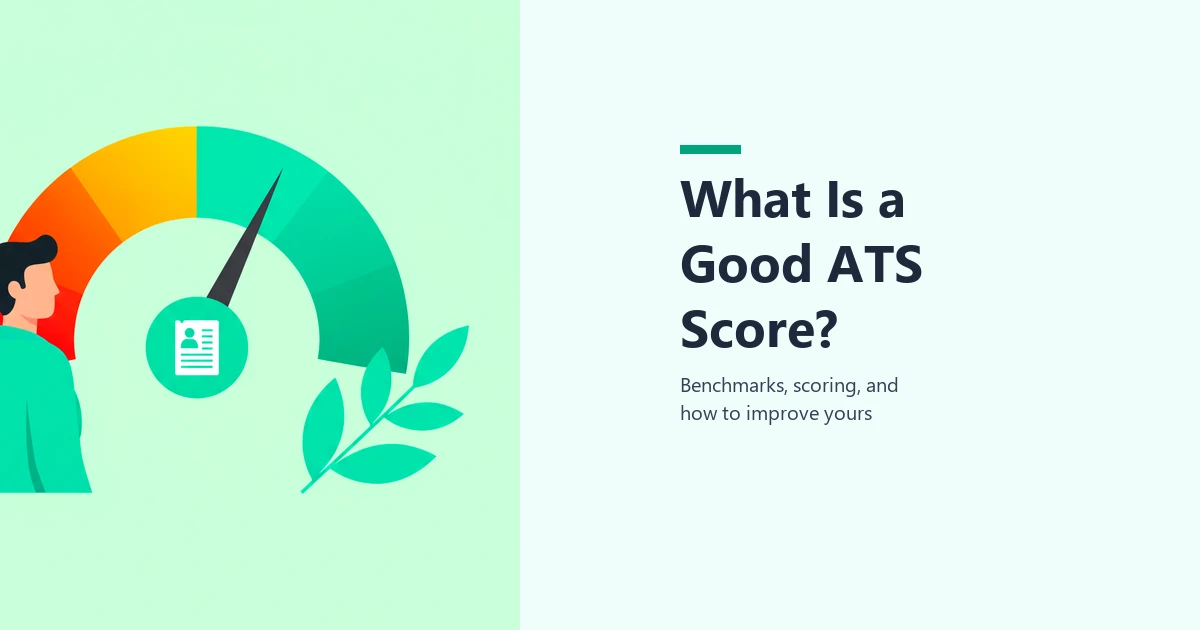
What is a Good ATS Score? Benchmarks, Scoring Explained & How to Improve
You ran your resume through an ATS checker and got a score of 62%. Now you're staring at the screen wondering: is that terrible? Should I rewrite the whole thing? Am I doomed?
Take a breath. ATS scores confuse almost everyone, and for good reason. There are over 200 different applicant tracking systems out there, each using different algorithms, and the internet is full of conflicting advice about what number you should aim for.
Here's the short answer: a good ATS score is 80% or higher. But there's a lot more to it than a single number. Let me break down exactly what ATS scores mean, how they're calculated, and what you can do to push yours into the range that actually gets interviews.
Key Takeaways
- A good ATS score is 80% or higher. That's the threshold where your resume consistently gets past automated screening and into human hands.
- ATS scores are match rates, not grades. They measure how well your resume aligns with a specific job description, not how good your career is.
- Every job produces a different score. The same resume can score 45% for one posting and 88% for another. That's normal.
- Scores are built from 5 components: Keyword Match (40%), Skills Alignment (20%), Experience Relevance (20%), Overall Presentation (10%), and Qualifications Match (10%).
- Going from 65% to 85% usually takes about 30 minutes of targeted edits. Tools like cvtailor.ai's ATS checker show you exactly what to fix.
What Does ATS Score Mean?
An ATS score is a match percentage that shows how well your resume lines up with a specific job description. Think of it less like a school grade and more like a compatibility score on a dating app.
When you submit your resume to a company, their applicant tracking system scans it and compares it against the job posting. It checks for keyword matches, relevant experience, proper formatting, and a handful of other factors. Then it assigns a score, usually from 0 to 100.
Here's what trips people up: your ATS score isn't a fixed number. It changes for every job you apply to. The same resume might score 88% for a marketing manager role and 52% for a data analyst position. That doesn't mean your resume is bad. It means the keywords and qualifications don't match that particular posting.
This is actually the most important thing to understand about ATS scores. They're not measuring your worth as a candidate. They're measuring how well your resume's language mirrors what the employer wrote in the job description.
How is ATS Score Calculated?
Your ATS score is built from five distinct components, each measuring a different aspect of how well your resume matches the job description. Here's how the 100 points break down:
| Component | Weight | What It Measures |
|---|---|---|
| Keyword Match | 40 points | How many of the job description's top keywords appear verbatim in your resume |
| Skills Alignment | 20 points | Whether the specific skills listed in the JD are demonstrated in your resume |
| Experience Relevance | 20 points | How closely your duties and achievements match the role's responsibilities |
| Overall Presentation | 10 points | Structure, formatting, grammar, conciseness, and readability |
| Qualifications Match | 10 points | Whether you meet the stated requirements (education, certifications, years of experience) |
Let's break each one down so you know exactly where your points are coming from.
Keyword Match (40 points)
This is the single biggest factor, worth 40% of your total score. The ATS pulls the top keywords from the job description (think hard skills, tools, certifications, industry terms) and checks whether each one appears in your resume.
The key here is direct matching. If the posting mentions "project management" and your resume says "managed projects," you might not get full credit. The system is looking for verbatim matches or very close industry-standard synonyms. This is why mirroring the exact language from the job description matters so much.
Skills Alignment (20 points)
Beyond raw keywords, the ATS evaluates whether your resume demonstrates the specific skills the role requires. Each skill from the job description gets scored:
- Exact Match: the skill is clearly listed or demonstrated in your duties and achievements (full points)
- Partial Match: a related skill is mentioned or your experience implies the skill (half points)
- No Match: the skill isn't mentioned or implied anywhere (zero points)
This is why listing skills isn't enough. If a role requires "data visualization" and you've written "Built executive dashboards in Tableau to track quarterly KPIs," that's a stronger match than just listing "Tableau" under skills.
Experience Relevance (20 points)
The ATS compares the responsibilities described in the job posting against the duties and achievements in your resume. It's looking for alignment between what they need done and what you've actually done.
Each responsibility gets scored the same way: close match (full points), partial match (half points), or no match (zero). The more your experience bullets mirror the job's responsibilities in terms of both action and outcome, the higher this component scores.
Overall Presentation (10 points)
This covers three sub-categories:
- Structure and formatting: clarity, consistency, use of headings and bullet points, readable layout
- Grammar and spelling: accuracy and professionalism throughout the document
- Conciseness and relevance: how focused your resume is on the target role, without unnecessary filler
This is where clean formatting earns its keep. Fancy graphics, tables, multi-column layouts, and unusual fonts can tank this score because the parser can't make sense of them. Stick to standard section headers, simple fonts, and a straightforward layout.
Qualifications Match (10 points)
The final component checks whether you meet the stated requirements: education level, certifications, years of experience, and any other hard qualifications listed in the posting. Each requirement is marked as met, not met, or not applicable, and points are distributed accordingly.
If a role requires "Bachelor's degree in Computer Science or related field" and "3+ years of Python experience," your resume needs to clearly show both. Burying your degree on page two or not specifying years of experience with Python costs you points here.
ATS Score Benchmarks: What Score Do You Need?
Here's the benchmark table that shows what each score range actually means for your job search:
| ATS Score Range | Rating | What It Means | Action Required |
|---|---|---|---|
| 0-50% | Poor | Major keyword and formatting gaps. Very likely to be auto-rejected. | Significant rewrite needed. Start fresh with the job description. |
| 50-70% | Fair | Some keyword matches but critical gaps remain. May pass for low-competition roles. | Add missing keywords, fix formatting issues, tailor your summary. |
| 70-85% | Good | Solid match. Should pass most ATS filters and reach human review. | Fine-tune keyword placement. You're close to the sweet spot. |
| 85-100% | Excellent | Strong alignment. Highest chance of landing interviews. | Submit with confidence. Focus on interview prep. |
A few things to keep in mind with these benchmarks. First, 100% is not the goal. Scores above 95% can actually raise red flags because they sometimes indicate keyword stuffing, where someone has copied chunks of the job description into their resume. Recruiters notice that, and it never looks good.
Second, the threshold that matters most is 80%. Research from multiple ATS platforms shows that resumes scoring 80% or higher see a dramatic jump in callback rates. Below 80%, you're competing in a much larger pool where most resumes get filtered out before a human ever sees them.
Is 70 a Good ATS Score?
A 70% ATS score puts you in an interesting spot. You're above the danger zone but below the comfort zone.
At 70%, your resume will probably pass ATS screening for positions that don't attract many applicants, say, under 50 applications. But for competitive roles at mid-to-large companies where hundreds of people apply? That 70% puts you right on the edge of getting filtered out.
Here's the encouraging part: the gap between 70% and 80% is usually smaller than people think. In most cases, you're looking at 3 to 5 missing keywords and maybe one or two formatting tweaks. That's 30 minutes of work, not a complete resume overhaul.
The most common fixes that push a 70% score into the 80s:
- Add the exact job title from the posting somewhere in your resume (summary or experience section)
- Mirror 2-3 key phrases you missed. If they say "stakeholder management" and you wrote "worked with clients," swap it.
- Include both acronyms and full terms. Write "Search Engine Optimization (SEO)" instead of just "SEO." ATS systems can be literal.
- Move your most relevant skills higher in your skills section. The order can affect how the ATS weights them.
Bottom line: 70% is workable but not ideal. Spend the time to push past 80% before you hit apply.
How to Get a 90+ ATS Score
Getting above 90% takes focused effort, but it's absolutely doable once you understand what ATS systems prioritize. Here's the process.
1. Mirror the Job Description Keywords
Open the job description and your resume side by side. Look for every hard skill, tool, certification, and industry term they mention. Your resume needs to contain those exact words.
- Use their exact phrasing. "Data visualization" and "data viz" are not the same thing to an ATS.
- Include both acronyms and spelled-out versions. "PMP (Project Management Professional)" covers both ways a system might search.
- Put keywords in context. "Managed $2M annual budget using SAP" scores better than just listing "SAP" under skills, because the ATS sees the keyword in a meaningful sentence.
2. Use a Clean, ATS-Friendly Format
Formatting problems are the silent score killers. Your resume might have perfect keywords and still score low because the ATS can't parse the layout.
- Stick to standard section headers: "Work Experience," "Education," "Skills," "Certifications." Creative headers like "Where I've Made Impact" confuse parsers.
- Avoid tables, columns, text boxes, and graphics. Most ATS systems can't read content inside these elements.
- Use a standard font (Arial, Calibri, Times New Roman, Garamond). Decorative fonts can cause character-recognition errors.
- Submit as PDF or DOCX. These are the two formats that virtually every ATS handles reliably.
3. Tailor Your Resume for Each Application
This is the step most people skip, and it's the one that makes the biggest difference. A generic resume will never score as high as one tailored to a specific job description.
For every application, adjust three things at minimum:
- Your professional summary should reflect the role's title and top 2-3 requirements
- Your skills section should mirror the posting's language and priority order
- Your experience bullets should lead with achievements that match what the employer emphasized
Doing this manually takes 30-45 minutes per application. cvtailor.ai automates the keyword matching and tailoring, cutting that down to under 5 minutes. You upload your resume, paste the job description, and it identifies the gaps and generates a tailored version.
4. Check Your Score Before You Apply
Never submit a resume without checking your ATS score first. It's like sending an email without proofreading it.
Here's the process that works:
- Upload your resume and the job description to an ATS score checker
- Review your match percentage and the specific keywords you're missing
- Make targeted edits (this usually takes 15-20 minutes)
- Re-test until you're at 80% or higher
- Then submit
This test-fix-retest cycle is what separates people who get callbacks from people who apply to 100 jobs and hear nothing.
What ATS Score Do I Need to Get an Interview?
Your ATS score directly affects your chances of hearing back. Here's what the data looks like:
| ATS Score | Estimated Callback Rate | What Happens |
|---|---|---|
| Below 60% | ~2-5% | Resume is auto-filtered. Almost never reaches a recruiter. |
| 60-70% | ~8-12% | May pass screening but ranks low. Only seen if applicant pool is small. |
| 70-80% | ~15-20% | Passes most filters. Reaches human review but isn't top of the pile. |
| 80-85% | ~30-35% | Strong match. Recruiter sees and reads your resume with interest. |
| 85-95% | ~40-50% | Top-ranked candidate. First resumes the recruiter reviews. |
Keep in mind: a high ATS score gets you past the automated filter, but the interview decision still comes down to a human. Once your resume reaches a recruiter, they're evaluating your actual experience, career narrative, and cultural fit. The ATS score just determines whether they see your resume at all.
That said, the numbers don't lie. Going from a 65% to an 85% ATS score can roughly triple your callback rate. That's the difference between sending 50 applications and hearing nothing versus sending 15 and getting 5-6 responses.
Common ATS Score Myths Debunked
There's a lot of bad advice floating around about ATS scores. Let's clear up the biggest misconceptions.
Myth: You should aim for 100%.
Reality: A perfect score isn't realistic and can actually hurt you. Scores above 95% sometimes flag keyword stuffing, which is when a resume contains an unnatural density of job description terms. Both ATS algorithms and human recruiters can detect this. Aim for 80-90%. That's the sweet spot.
Myth: Your ATS score is the same for every job.
Reality: Your score changes with every job description you compare against. A data analyst resume might score 90% for a data analyst posting and 40% for a product manager role. That's exactly how it should work. This is why tailoring your resume for each application matters so much.
Myth: ATS only looks at keywords.
Reality: Keywords account for the largest single component (40%), but they're only part of the picture. ATS systems also score your skills alignment (20%), experience relevance (20%), overall presentation (10%), and qualifications match (10%). A well-structured resume that demonstrates relevant experience with keywords in context will outscore a keyword-stuffed mess every time.
Myth: You can trick the ATS with white text.
Reality: The old trick of pasting job description keywords in white text (invisible to humans, visible to ATS) hasn't worked in years. Modern ATS platforms detect hidden text and penalize resumes that use it. Some will flag your application for fraud. Don't do this.
Myth: All ATS platforms score the same way.
Reality: There are over 200 ATS platforms (Greenhouse, Lever, Workday, Taleo, iCIMS, and more), and each weighs factors differently. Greenhouse might emphasize experience duration while Lever puts more weight on specific skills. This is why a score from one tool is an approximation, not an absolute. But 80%+ on any reputable checker means you're in good shape across most systems.
Check Your ATS Score with cvtailor.ai
Wondering where your resume stands right now? Here's the fastest way to find out.
cvtailor.ai was built specifically to solve the ATS scoring problem. The workflow takes about 2 minutes:
- Upload your resume (PDF or DOCX)
- Paste the job description from any posting you're targeting
- Get your ATS match score with a breakdown of exactly which keywords you're missing
- Auto-tailor your resume to fill the gaps and boost your score
You can check scores for free and see precisely what needs to change. No guesswork, no manually comparing documents side by side, no wondering if your resume will make it through.
The difference between a 60% and an 85% ATS score is often just a handful of keyword swaps and some reordering. cvtailor.ai shows you exactly which swaps to make.
What's Your ATS Score?
Find out in 30 seconds. Upload your resume and get your match percentage instantly.
Check Your ATS Score FreeFrequently Asked Questions
What is a good ATS score?
A good ATS score is 80% or higher. At this level, your resume will pass most automated screening systems and consistently reach human recruiters. Scores between 70-79% are decent but risky for competitive roles, while below 60% typically means automatic rejection. For highly competitive positions at large companies, aim for 85% or above to maximize your chances of getting an interview.
Is 70 a good ATS score?
A 70% ATS score is moderate. It will pass screening for less competitive roles with fewer applicants, but it puts you at risk of being filtered out for popular positions at larger companies. The good news is that jumping from 70% to 80%+ usually requires only 3-5 missing keywords and minor formatting adjustments, about 30 minutes of targeted work.
How do I get a 90+ ATS score?
To score 90%+, mirror the exact keywords and phrases from the job description, use both acronyms and full terms (e.g., "SEO" and "Search Engine Optimization"), place keywords in meaningful sentences rather than just listing them, use ATS-friendly formatting with standard section headers, and tailor your resume specifically for each application. Tools like cvtailor.ai can automate the keyword matching process and identify exactly which terms you're missing.
What does ATS score mean?
An ATS score is a match percentage (0-100) that measures how well your resume aligns with a specific job description. It's calculated by an applicant tracking system that compares your resume's keywords, experience, and formatting against what the employer specified in the job posting. The score is not a universal rating of your resume. It changes for every different job description you apply to.
How is ATS score calculated?
ATS scores are calculated from five components: Keyword Match (40 points) checks whether the job description's top keywords appear verbatim in your resume; Skills Alignment (20 points) evaluates whether you demonstrate the required skills; Experience Relevance (20 points) compares your duties and achievements against the role's responsibilities; Overall Presentation (10 points) assesses formatting, grammar, and conciseness; and Qualifications Match (10 points) checks whether you meet stated requirements like education and certifications. Keywords in context score higher than keywords listed in isolation.
What ATS score do I need to get an interview?
While there's no guaranteed threshold, data shows clear patterns: resumes scoring below 60% have roughly a 2-5% callback rate, 70-80% scores see about 15-20%, and 80%+ scores reach 30-50% callback rates. Aiming for 80% or higher gives you the best chance of your resume reaching a human recruiter, who then makes the final interview decision.
Related Articles

How to Tailor Your Resume to a Job Description (Step-by-Step Guide)
Learn how to tailor your resume to a job description in 7 simple steps. Match keywords, beat ATS screening, and land more interviews with this proven method.
8 Best AI Resume Services with Personal Advisory 2025
Explore eight top AI resume platforms offering tailored advisory, ATS optimization, and user-specific features to help boost your job application success.
Best AI Resume Builders for CV Optimization and ATS Success 2025
Compare and review 10 leading AI resume builders for 2025, focusing on ATS optimization, feature sets, pricing, and user-specific job search support.